September 2018 - December 2021: PhD in Cosmology at Laboratoire Astroparticules et Cosmology (APC)
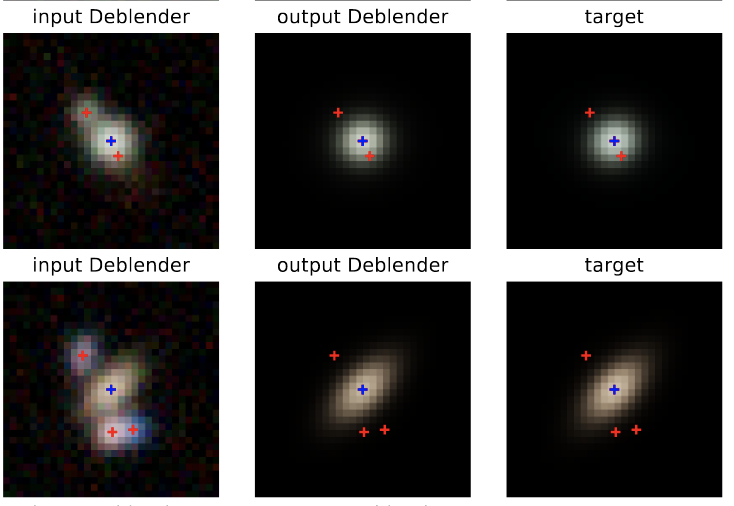
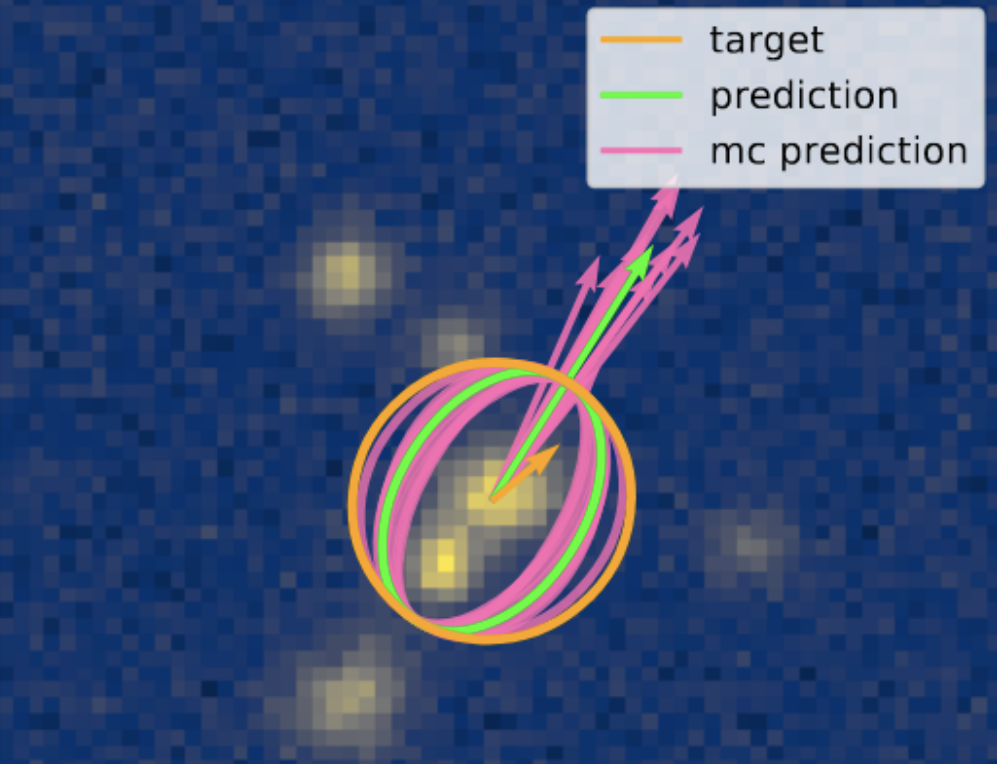
During my PhD, I used Bayesian deep learning algorithms to tackle the issue of overlapping sources (an effect called "blending"), such as galaxies or stars.
I developped two methods. The first one is based on Variational AutoEncoders (VAE), a particular type of deep generative models.
I managed to design a method enabling the separation of galaxies on an image using VAEs, which led to
a publication in MNRAS.
The second method is based on Bayesian neural networks and provides a direct measurement of galaxy parameters probability distribution from scenes of overlapping sources.
Bayesian neural networks were used to provide an estimation of the epistemic uncertainty, a necessary step when aiming for reliable measurements from neural networks. For this work
I collaborated with people from LORIA in the context of the Astrodeep
project. It led to a publication at ECML-PKDD 2021 and a second one is envisaged in the near future.
I was also one of the main organisers of the "Bayesian deep learning for cosmology and gravitational waves" workshop that was held in March 2020 in Paris.
For that event, we gathered more than 70 participants from different academic fields (cosmology, gravitational waves, and computer science mostly) and from the industry (Google, Microsoft, LightOn and Graphcore).
This was a very successful meeting where people from different fields could interact. It led to a personal side project,
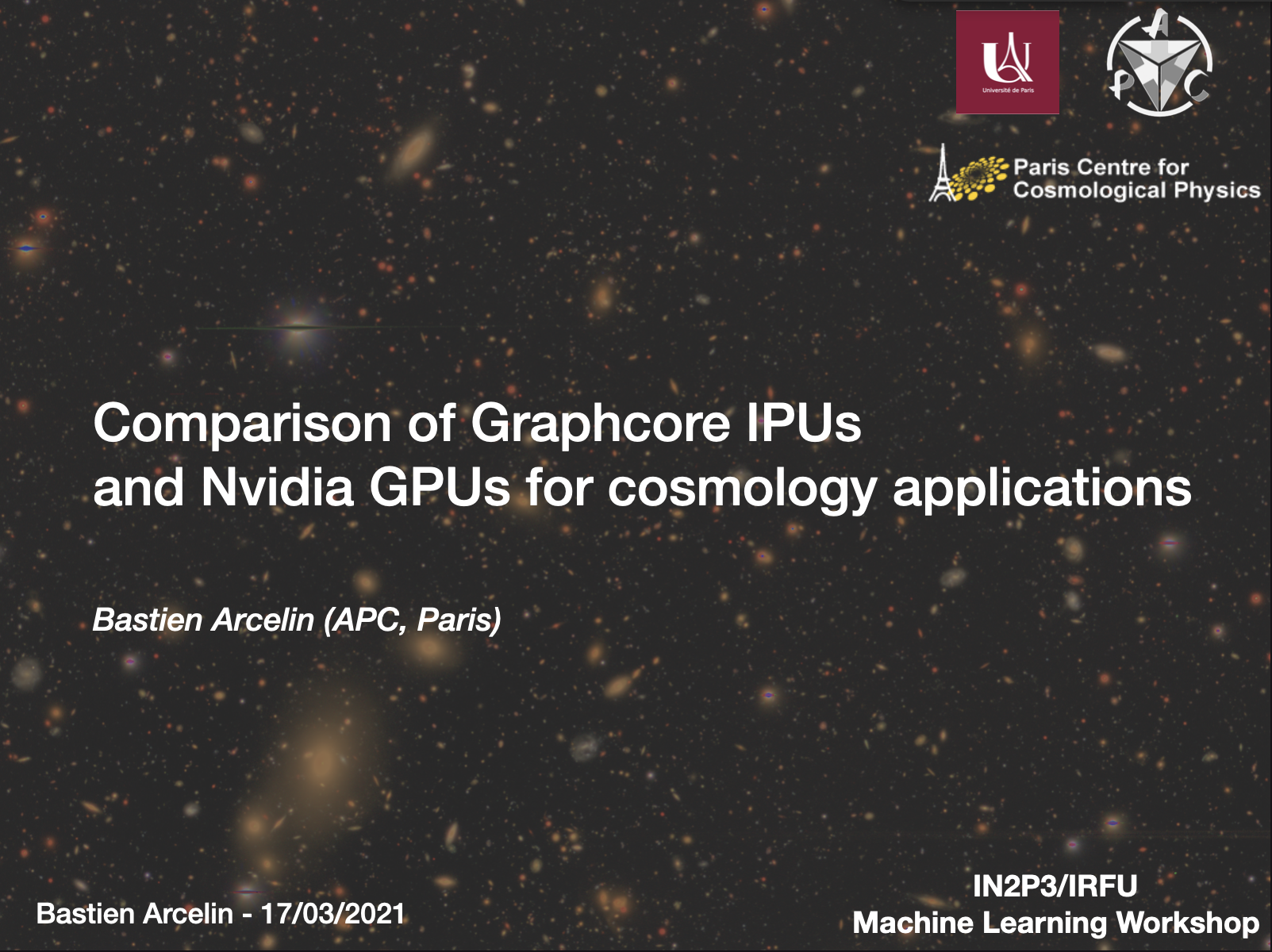
comparing the performances of Nvidia GPU with Graphcore IPU for cosmology applications. A summary of the paper,
under the form of blog post and interview, can be found here.
I had the opportunity to present my different works in several conferences including international ones such as LSST Dark Energy Science Collaboration meetings.
During that time I also teached at the Université de Paris to first year students. I started teaching "Tools for computing" during my first year of PhD
and switched to "Interactions between Mathematics and Physics" in my second year.
February 2014 - September 2017: Nuclear engineer at Areva NP (now Framatome)
I worked in a team in charge of simulating and analysing accidental situations on nuclear french power plants for the writing of safety reports.
These safety reports were written for the two french nuclear safety agencies, the ASN (Autorité de Sûreté Nucléaire) and the
IRSN (Institut de Radioprotection et Sûreté Nucléaire).
The computations used thermohydraulic codes such as
MANTA or CATHARE
allowing for the simulation of different nuclear plant systems. The data analyses were then perfomed to write safety reports, upstream mechanical analyses.
During that time also did more exploratory work, looking for specific situations for particular areas of the primary system, in close relationship with mechanical engineers and EDF. I also
had the opportunity to work on Japonese power plants.
September 2013 - February 2014: Nuclear Safety engineer at Assystem
I was assigned in a team of safety engineers at SOFINEL for the Taishan EPR (Evolutionary Power Reactor). My work focused on the impact of the loss of electrical power panels and I wrote analyses reports to include into the
post-accidental instructions.